Wooden Digital Record Player
Project Overview
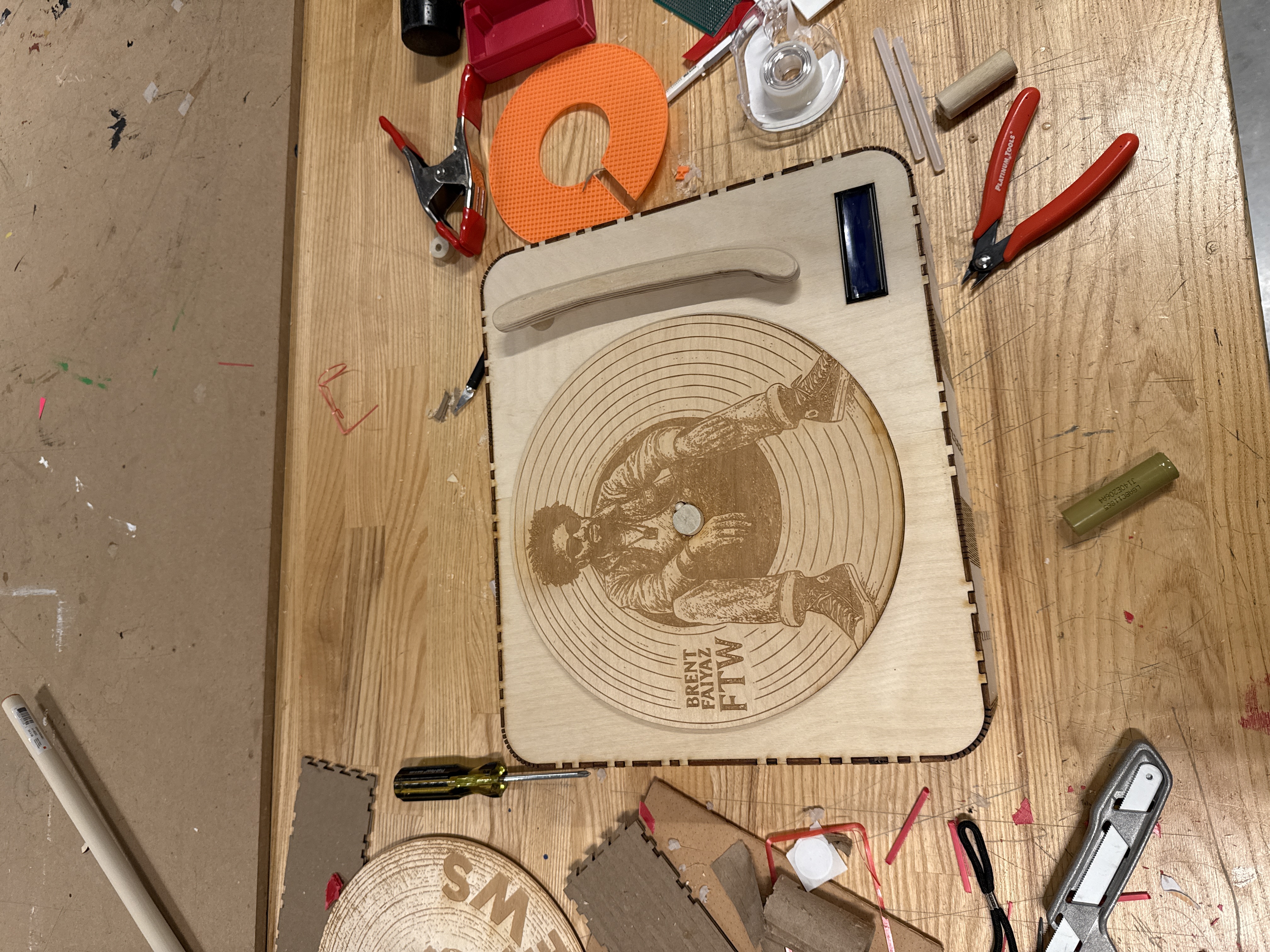
A digital record player that bridges the tactile ritual of vinyl with modern streaming technology. Custom laser-engraved wooden disks with embedded RFID tags act as physical "records" that trigger Spotify playback when placed on the turntable, recreating the deliberate, album-focused listening experience of vinyl in the digital age.
Context & Motivation
This personal project emerged from my fascination with the physicality of record players—the weight of a disk, the deliberate act of choosing an album, the slow commitment to listening. While I rely on streaming for its flexibility and access, I missed the intentional ritual of vinyl. This project lives in that intersection, translating the motions and feelings of playing records into a system that belongs in the present.
Design Philosophy
My goal was not to recreate the tech of vinyl, but to extend the human ritual of album listening. Wood was chosen for its warmth and permanence, grounding digital playback in something tangible. RFID technology allows the electronics to disappear entirely, keeping the interaction physical and intuitive. All components are hidden within the wooden enclosure, allowing the object to present as furniture rather than consumer technology.
How It Works
When a wooden disk is placed on the player, the RFID reader detects the embedded tag and triggers a Spotify API call to play the hard-coded album. The disk begins rotating, and the LCD display instructs the user to place the tonearm over the spinning record. When the tonearm makes contact, a mechanical switch triggers playback through the embedded speaker. Moving the tonearm off pauses the music and stops rotation. Returning it resumes playback seamlessly, just like a traditional record player.
Hardware Stack
Core System
- Raspberry Pi 4 Model B - Main processing unit, runs Python control script, manages Wi-Fi connectivity
Disk Recognition
- MFRC522 RFID Reader - Reads embedded tags via SPI to identify albums
- RFID Tags - Embedded in wooden disks, each linked to a Spotify URI
Mechanical Interface
- MG90S Servo Motor - Controls record rotation with PWM
- Pushbutton Switch - Wired to GPIO D9 using INPUT_PULLUP for manual control
- Laser-Cut Wooden Disks - Custom engraved with album artwork and embedded RFID
Display & Audio
- I2C LCD Display (16x2) - Shows track title, artist, and status messages
- Bluetooth Speaker - Embedded audio output
Power Management
- Buck Converter - Steps down 12V input to 5V for peripherals
- USB Step-Down Converter - Stable 5V supply for Raspberry Pi via USB-C
Software Architecture
Python Control Script
The core Python script orchestrates all system functions:
- Monitors RFID input via SPI using the MFRC522 library
- Authenticates and controls Spotify playback through Spotipy (Spotify Web API wrapper)
- Controls servo motor with GPIO PWM for smooth rotation
- Updates LCD display using smbus and I2C_LCD_driver for real-time feedback
- Handles button interrupts with GPIO event detection
Spotify Integration
- User authentication via OAuth 2.0
- Album/playlist search and playback control
- Real-time track metadata sent to LCD display
- Playback state management (play, pause, resume)
Fabrication Process
Enclosure Design
After researching classic record player proportions, I designed a rectangular base with rounded corners in Adobe Illustrator. The DXF files included living hinges for curved edges and interlocking tabs for structural integrity. The design balances aesthetic warmth with practical assembly.
Record Creation
Custom wooden disks were designed in Inkscape, starting with album cover art and adding graphic elements. With ChatGPT's assistance, I refined vector files and prepared them in Illustrator for laser cutting. Each disk contains an RFID tag on the underside, invisible but functional.
Laser Cutting
Both the enclosure and records were cut and engraved using a Glowforge laser cutter. The living hinge pattern allows flat wooden sheets to curve elegantly, while precise tolerances ensure smooth disk rotation and reliable RFID detection.
Tools & Technologies
- Inkscape - Album art vectorization and record layout design
- Adobe Illustrator - DXF file preparation for laser cutting
- Fusion 360 - Enclosure prototyping and component fitting
- Glowforge / Epilog Laser Cutter - Cutting and engraving wooden components
- ChatGPT - Vector file refinement and design assistance
Technical Challenges
- RFID Detection Reliability - Optimized tag placement and reader positioning to ensure consistent detection through wood grain
- Servo Timing - Synchronized servo rotation with Spotify API calls to create seamless start/stop behavior
- Mechanical Precision - Designed living hinges and tabs to balance flexibility with structural stability
- User Feedback Loop - Integrated LCD to provide clear status updates during the interaction flow
- Power Distribution - Managed voltage requirements across multiple components with efficient step-down converters
Key Features
- Seamless physical-to-digital interaction with no visible technology
- Tonearm-controlled playback mimicking traditional vinyl experience
- Real-time track information on integrated LCD display
- Custom laser-engraved album artwork on each wooden disk
- Elegant living hinge construction for curved wooden edges
- Complete Spotify integration with OAuth authentication
Project Reflection
This project represents my philosophy on technology design: tools should extend human rituals, not replace them. By preserving the pause before sound and the physical commitment to an album while maintaining modern flexibility, the Wooden Digital Record Player exists as both a functional music player and a meditation on how we interact with media. It's a reminder that the best technology often feels like no technology at all.
Questions?
If you have any questions or comments, feel free to reach out via hayleybloch@college.harvard.edu